Your shoulders are probably hunched right now. Maybe your jaw is clenched tight enough to crack a walnut, and that low-level hum of anxiety has been playing in the background of your mind all day. We live in a world that rewards constant motion, endless notifications, and the illusion that we can multitask our way to happiness. But here is the hard truth: you cannot pour from an empty cup. If you want to think clearly, act decisively, and actually enjoy your life, you need to learn how to hit the pause button. It isn’t about escaping reality; it is about resetting your nervous system so you can handle reality with grace.
Relaxation is not a luxury item you buy when things get better. It is a biological necessity. When you are stressed, your body releases cortisol and adrenaline. These hormones are great for running away from a bear, but terrible for writing a report or listening to your partner. Over time, chronic stress rewires your brain to be hyper-vigilant. The good news? You have the power to reverse this process. You just need the right tools. Below are ten proven relaxation techniques that you can start using today, right where you are sitting.
1. Box Breathing (The Navy SEAL Method)
If you have ever watched action movies, you might know that Navy SEALs use box breathing to stay calm under extreme pressure. Why would special forces need this? Because high-stakes situations trigger panic, and panic kills performance. This technique works by manually regulating your autonomic nervous system. It forces your heart rate down and signals safety to your brain.
Here is how you do it:
- Inhale through your nose for a count of four.
- Hold that breath for a count of four.
- Exhale slowly through your mouth for a count of four.
- Hold your lungs empty for a count of four.
Repeat this cycle four times. It feels awkward at first because holding your breath triggers a primal urge to inhale. Push past that urge. That discomfort is your body learning a new pattern. Use this before a big meeting, during a traffic jam, or whenever you feel that spike of anger rising in your chest.
2. Progressive Muscle Relaxation (PMR)
Sometimes your mind won’t stop racing because your body is holding onto tension you didn’t even notice. Progressive Muscle Relaxation, developed by physician Edmund Jacobson in the 1920s, is based on a simple principle: you cannot be physically tense and mentally relaxed at the same time. By systematically tensing and then releasing muscle groups, you create a stark contrast that helps you identify and drop hidden stress.
Start with your feet. Curl your toes tightly for five seconds, feeling the strain in your arches. Then, release suddenly and let go for ten seconds. Notice the difference between the tension and the relaxation. Move up to your calves, thighs, buttocks, stomach, hands, shoulders, and finally your face. Scrunch your eyes shut and furrow your brow, then release. You will likely feel a wave of warmth spread through your limbs. This is blood flow returning to areas that were constricted by stress.
3. The 5-4-3-2-1 Grounding Technique
Anxiety often pulls us into the future-worries about what might happen-or the past-regrets about what did happen. The 5-4-3-2-1 technique drags you back to the present moment by engaging your senses. This is particularly effective if you are having a panic attack or feeling overwhelmed by emotional noise.
Look around you and name:
- 5 things you can see: A pen, a crack in the wall, a blue shirt, a shadow, a plant.
- 4 things you can physically feel: The fabric of your chair, the air on your skin, your feet on the floor, your hair on your neck.
- 3 things you can hear: Traffic outside, the hum of the fridge, birds chirping.
- 2 things you can smell: Coffee, soap, rain.
- 1 thing you can taste: Toothpaste, water, or just the inside of your mouth.
This simple exercise interrupts the loop of catastrophic thinking. It reminds your brain that you are safe in this exact second.
4. Mindful Walking
You don’t need a meditation cushion to practice mindfulness. In fact, some people find sitting still more stressful than moving. Mindful walking turns a mundane activity into a powerful reset. Instead of walking while planning your dinner or rehearsing an argument, you walk with full attention on the act of walking.
Pay attention to the sensation of your heel hitting the ground. Feel the roll of your foot onto the toe. Notice the swing of your arms. Feel the wind against your face. If your mind wanders-and it will-gently bring it back to your feet. This practice connects you with your physical body and breaks the cycle of mental rumination. Even a five-minute mindful walk around your office block can lower your cortisol levels significantly.

5. Guided Imagery
Your brain doesn’t always distinguish well between vividly imagined experiences and real ones. Athletes use visualization to improve performance; you can use it to induce relaxation. Guided imagery involves creating a detailed mental scene of a peaceful place. It could be a beach in Bali, a cabin in the mountains, or a quiet library.
Close your eyes and build the scene. What does the sand look like? Is it white or gold? Can you hear the waves crashing? Smell the salt air? Feel the warmth of the sun on your shoulders? Engage as many senses as possible. Stay in this mental space for five to ten minutes. This technique lowers blood pressure and reduces pain perception by distracting the brain from stressors.
6. Journaling Brain Dump
Often, our minds are cluttered because we are trying to hold too much information at once. To-do lists, worries, ideas, memories-it’s all swirling in a chaotic mix. Writing it down gets it out of your head and onto paper, where it becomes manageable. This is called a "brain dump."
Set a timer for ten minutes. Write everything that is on your mind. Do not worry about grammar, spelling, or structure. Just let the words flow. Once the timer goes off, look at what you wrote. Circle the items that require action and cross out the ones that are just worries you can’t control. This externalizes your stress and gives you a clear path forward.
7. Cold Water Splash (The Mammalian Dive Reflex)
Need an immediate reset? Splash cold water on your face or hold an ice cube in your hand. This triggers the mammalian dive reflex, an ancient survival mechanism that slows your heart rate to conserve oxygen when you are underwater. It instantly activates the parasympathetic nervous system, which is responsible for rest and digestion. It is a quick, physiological hack to stop a spiral of anxiety in its tracks.
8. Digital Detox Hour
Our devices are designed to keep us engaged, often at the cost of our peace. Notifications, emails, and social media feeds create a state of continuous partial attention. Your brain never gets a chance to fully relax because it is always scanning for the next input. Try turning off all non-essential notifications for one hour each day. Put your phone in another room. Use this time to read a book, cook, or simply sit quietly. You will be surprised at how much calmer you feel after disconnecting.
9. Aromatherapy with Lavender
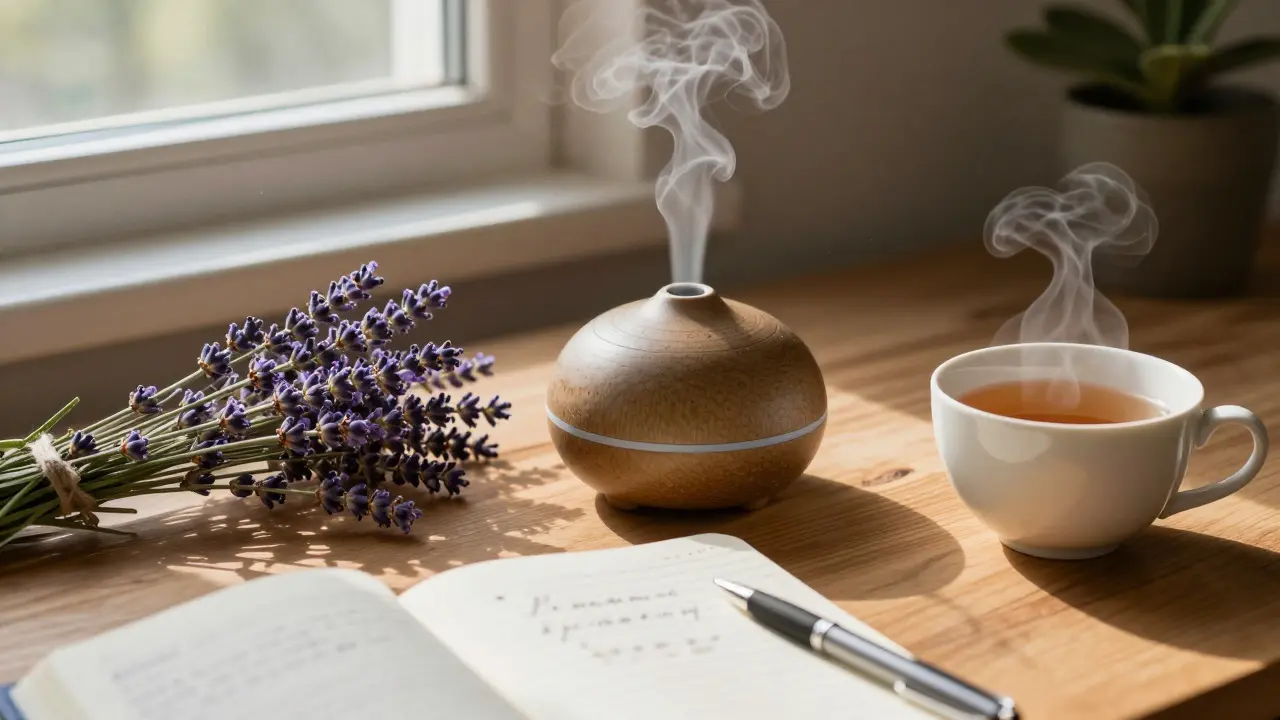
Scent has a direct line to the limbic system, the part of the brain that controls emotions and memory. Studies have shown that inhaling lavender essential oil can reduce anxiety and improve sleep quality. Keep a small bottle of lavender oil at your desk or home. Add a few drops to a diffuser, or dab a tiny amount on your wrists. The calming effect is subtle but cumulative over time.
10. Gratitude Reflection
It sounds cliché, but gratitude is scientifically proven to boost mood and reduce stress. When you focus on what is going wrong, your brain scans for threats. When you focus on what is going right, your brain scans for opportunities and connections. Each night, write down three specific things you are grateful for. Not just "my family," but "the way my daughter laughed at breakfast." Specificity matters. This shifts your mindset from scarcity to abundance, making stress feel less overwhelming.
| Technique | Best For | Time Required | Difficulty Level |
|---|---|---|---|
| Box Breathing | Immediate calm, high-stress moments | 2-5 minutes | Easy |
| Progressive Muscle Relaxation | Physical tension, insomnia | 10-15 minutes | Medium |
| 5-4-3-2-1 Grounding | Panic attacks, anxiety spikes | 1-3 minutes | Easy |
| Mindful Walking | Rumination, restlessness | 5-20 minutes | Easy |
| Journaling Brain Dump | Mental clutter, decision fatigue | 10 minutes | Easy |
Building a Sustainable Relaxation Practice
Knowing these techniques is one thing; using them consistently is another. Most people try to meditate for an hour every morning and fail within a week. The key is consistency, not duration. Start small. Pick one technique that resonates with you and practice it for two minutes a day. Attach it to an existing habit, like brushing your teeth or drinking your morning coffee. This is called habit stacking.
As you become more comfortable, gradually increase the time. Remember, relaxation is a skill. Like any skill, it requires practice. Some days will be harder than others. On those days, be kind to yourself. Acknowledge the stress, take a deep breath, and try again tomorrow. Your mind is resilient. With the right tools, you can revitalize it and reclaim your peace.
How long does it take for relaxation techniques to work?
Some techniques, like box breathing or cold water splashing, provide immediate relief by activating the parasympathetic nervous system. Others, like mindfulness meditation or gratitude journaling, build their benefits over time. Research suggests that consistent practice for 4-8 weeks can lead to measurable changes in brain structure and stress response.
Can I do these techniques at work?
Absolutely. Box breathing, the 5-4-3-2-1 grounding technique, and mindful walking can be done discreetly in most office environments. They require no equipment and can be completed in just a few minutes, making them perfect for busy workdays.
Is meditation the only way to relax?
No. Meditation is just one tool among many. Physical activities like yoga or walking, sensory practices like aromatherapy, and cognitive strategies like journaling are all effective ways to reduce stress. Find what works best for your personality and lifestyle.
What if I can't stop my thoughts from wandering?
Wandering thoughts are normal. The goal of mindfulness is not to stop thinking, but to notice when your mind has wandered and gently bring it back. Each time you redirect your attention, you are strengthening your focus muscle. Be patient with yourself.
Are there any risks associated with relaxation techniques?
Generally, relaxation techniques are safe. However, if you have a history of trauma or severe anxiety, certain practices like deep breathing or guided imagery might initially intensify feelings. If this happens, stop the practice and consult a mental health professional. They can guide you through trauma-informed relaxation methods.